
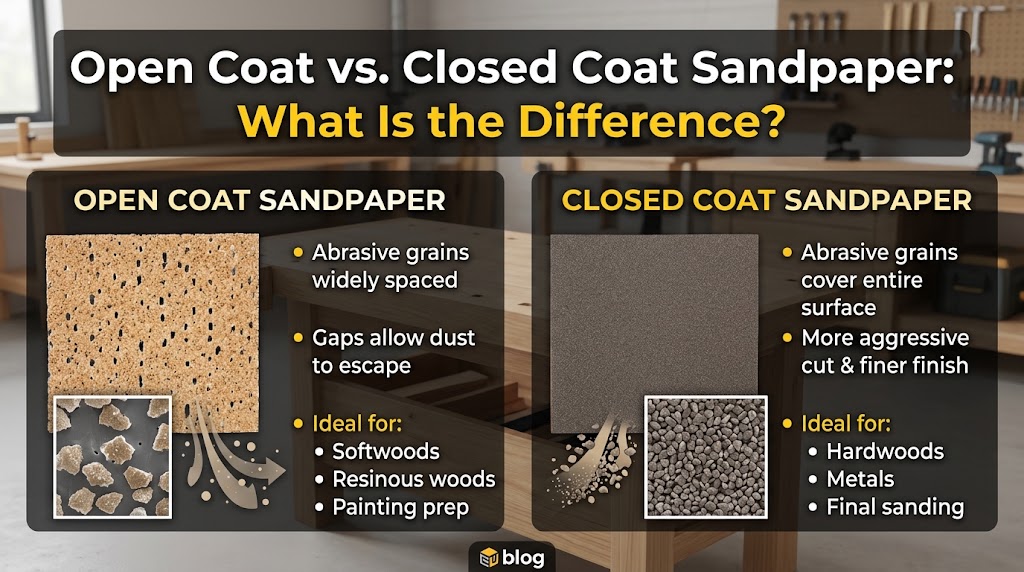
Open coat and closed coat sandpaper differ mainly in how much of the backing is covered by abrasive grains. Open coat abrasives have more space between grains, which helps reduce loading and makes them useful for materials that generate a lot of dust or residue. Closed coat abrasives have a higher grain coverage, providing more cutting points and a more consistent scratch pattern. The right choice depends on the material, sanding stage, desired finish, and production requirements.
Open Coat vs. Closed Coat Sandpaper: What Is the Difference?
When buying coated abrasives, it is easy to focus on grit number and overlook another specification that can have a major effect on sanding performance: abrasive coat density.
Two sandpapers can have the same grit, backing, and dimensions but behave differently because one uses an open coat and the other uses a closed coat.
This difference matters for both end users and abrasive buyers. A sandpaper that works well on one material may load quickly, cut inefficiently, or produce an unsuitable finish on another. For distributors, manufacturers, and businesses purchasing coated abrasives in volume, understanding the coating structure can also make it easier to compare products and specifications.
So what is the difference between open coat and closed coat sandpaper, and when should each one be used?
What Does “Coat” Mean in Sandpaper?
In coated abrasives, the abrasive grains are bonded to a backing material such as paper, cloth, film, or a combination of materials. The grains form the cutting surface that removes material during sanding.
Coat density refers to how closely the abrasive grains are distributed across the backing.
In simple terms:
- Open coat: abrasive grains cover a smaller percentage of the backing, leaving more space between individual grains.
- Closed coat: abrasive grains are distributed more densely, covering most of the backing surface.
This may look like a small manufacturing detail, but it affects how the abrasive interacts with the workpiece, how easily dust can move away from the sanding surface, and how quickly the abrasive becomes loaded.
What Is Open Coat Sandpaper?
Open coat sandpaper has abrasive grains spaced farther apart than those on a closed coat abrasive. The gaps between grains create additional room for sanding dust, chips, and other debris to move away from the cutting surface.
The main advantage is improved resistance to loading.
Loading occurs when removed material builds up between or around abrasive grains. Once an abrasive becomes heavily loaded, fewer grains are available to cut the workpiece effectively. The surface may begin to feel smooth even though the sandpaper still appears usable.
Open coat construction can help delay this problem, particularly when sanding materials that produce a large amount of dust or generate sticky sanding residue.
Typical advantages of open coat abrasives
- More space for sanding debris
- Better resistance to loading in many applications
- Useful for materials that generate significant dust
- Can provide a more forgiving sanding action
- Often suitable for wood sanding and similar applications
However, open coat does not automatically mean “better.” The lower grain density also means there are fewer abrasive grains contacting the workpiece at a given moment. That can make open coat less suitable when maximum cutting density or a highly uniform scratch pattern is the priority.
What Is Closed Coat Sandpaper?
Closed coat sandpaper has a much higher concentration of abrasive grains across the backing. The grains are positioned relatively close together, creating a dense cutting surface.
Because more abrasive grains can contact the workpiece, closed coat abrasives can provide efficient material removal and a consistent scratch pattern when the abrasive is correctly matched to the application.
Closed coat construction is commonly considered when sanding harder materials, performing finishing operations, or when a dense and consistent abrasive surface is desirable.
Typical advantages of closed coat abrasives
- Higher abrasive grain density
- More cutting points across the sanding surface
- Consistent scratch distribution
- Effective material removal in suitable applications
- Useful for many metal and finishing applications
The trade-off is that the smaller spaces between grains can provide less room for sanding debris. As a result, some closed coat abrasives can load faster than an appropriately designed open coat product, especially when sanding soft, resinous, painted, or otherwise clogging materials.
Open Coat vs. Closed Coat: Key Differences
| Feature | Open Coat | Closed Coat |
|---|---|---|
| Grain density | Lower | Higher |
| Space between grains | More | Less |
| Loading resistance | Generally better | Generally lower |
| Cutting density | Moderate | High |
| Debris clearance | More space available | Less space available |
| Common applications | Wood and clogging-prone materials | Metal, finishing, and dense cutting applications |
Why Does Coat Density Affect Sanding Performance?
The most important point is that abrasive grains need to remain exposed and sharp enough to cut.
During sanding, the abrasive removes material and generates particles. Those particles need somewhere to go. If they accumulate around the abrasive grains, the effective cutting surface decreases.
This is why coat density is closely related to loading behavior.
An open coat provides more empty space around the grains. This can make it easier for dust and sanding debris to move away from the cutting points. A closed coat puts more grains into the same area, increasing the number of potential cutting points but leaving less open space.
In practice, however, coat density is only one part of abrasive performance. Grain type, grain size, backing material, bonding system, coating technology, lubrication, sanding pressure, machine speed, and the material being sanded can all change the result.
Which Is Better for Wood: Open Coat or Closed Coat?
For many wood sanding applications, open coat sandpaper can be a practical choice because wood creates a significant amount of sanding dust and some wood species can cause abrasive loading.
Open spacing gives the removed material more room around the abrasive grains. This can help maintain cutting performance for longer compared with an unsuitable densely coated abrasive.
However, the answer depends on the wood and the sanding operation. Solid wood, MDF, plywood, veneer, painted wood, and lacquered surfaces do not behave exactly the same way.
For production woodworking, it is therefore better to evaluate the complete abrasive construction rather than choosing solely based on “open coat” or “closed coat.”
Which Is Better for Metal?
Closed coat abrasives are often considered for metal sanding because their higher grain density provides a large number of cutting points.
They can be useful for applications where material removal, scratch consistency, or controlled finishing is important.
But metal sanding also creates its own challenges. Aluminum, stainless steel, and other metals can behave differently during abrasion. Aluminum, for example, can create loading problems if the abrasive construction is not suitable.
This is why simply choosing a closed coat abrasive because it has more grains is not enough. The abrasive grain type and anti-loading characteristics also need to be considered.
What About Automotive Paint and Primer?
Automotive refinishing can involve several different materials during one repair, including old paint, primer, body filler, and bare metal.
The ideal abrasive construction can therefore change from one sanding stage to another.
For example, an abrasive designed for aggressive material removal may not be the best choice for final surface preparation. Likewise, an abrasive that performs well on bare metal may load differently when used on paint or filler.
For automotive applications, buyers should consider coat density together with abrasive grain, grit, backing, hole pattern, and anti-loading technology.
Abrasive Selection Tip
If loading is your main problem, do not automatically switch to a coarser grit. First check whether the abrasive construction, coating density, backing, and anti-loading characteristics are appropriate for the material.
Does Open Coat Always Last Longer?
Not necessarily.
It is tempting to assume that because open coat abrasives can resist loading, they will always have a longer working life. Real-world abrasive life is more complicated.
Sandpaper performance depends on how quickly the abrasive loses effective cutting ability compared with how quickly the workpiece causes loading or wear.
A closed coat abrasive may provide more cutting points and remove material efficiently. An open coat abrasive may remain cleaner for longer. Which one lasts longer depends on the material, sanding conditions, abrasive grain, backing, bonding system, and application.
For industrial users, the better measurement is often not simply price per sheet or price per disc, but the total amount of material that can be processed before the abrasive needs to be replaced.
How Should Buyers Choose Between Open and Closed Coat?
If you are sourcing coated abrasives for distribution, manufacturing, or regular production use, consider these questions before selecting a specification:
- What material are you sanding? Wood, metal, paint, plastic, filler, and composites can require different abrasive constructions.
- How much material needs to be removed? Heavy stock removal and fine finishing may call for different abrasive characteristics.
- Is loading a common problem? If the abrasive clogs quickly, an open coat or an anti-loading construction may be worth evaluating.
- What surface finish is required? Scratch consistency becomes increasingly important during finishing operations.
- What sanding equipment is being used? Hand sanding, orbital sanding, belt sanding, and other processes create different operating conditions.
- How important is abrasive life? In high-volume operations, a slightly higher unit cost may make sense if the abrasive provides better productivity.
Open Coat vs. Closed Coat: There Is No Universal Winner
The choice between open coat and closed coat sandpaper is not about deciding which construction is universally better. It is about matching abrasive structure to the job.
Open coat is generally advantageous when loading resistance and debris clearance are important. It can be particularly useful for wood and other materials that generate substantial sanding residue.
Closed coat provides a denser concentration of abrasive grains and can be a strong choice when high cutting density and consistent abrasion are priorities.
For professional and industrial applications, the best abrasive specification often comes from evaluating several factors together rather than choosing based on grit or coat density alone.
Frequently Asked Questions
What is open coat sandpaper?
Open coat sandpaper has abrasive grains distributed with more space between them. This open structure provides additional room for sanding debris and can help reduce loading.
What is closed coat sandpaper?
Closed coat sandpaper has a higher concentration of abrasive grains across the backing. It provides a dense cutting surface and can offer consistent abrasion in many applications.
Is open coat sandpaper better for wood?
Open coat sandpaper is often suitable for wood because the additional space between abrasive grains can help manage sanding dust and reduce loading. The best construction still depends on the wood species and sanding operation.
Is closed coat sandpaper better for metal?
Closed coat abrasives are commonly suitable for metal because their higher grain density provides many cutting points. However, grain type, backing, loading resistance, and the specific metal should also be considered.
Does open coat sandpaper prevent clogging?
Open coat construction can reduce the tendency to load because there is more space between grains, but it does not completely prevent clogging. Material, grit, coating technology, pressure, and sanding conditions also affect loading.
Can the same grit be available in both open and closed coat?
Yes. Grit size and coat density describe different characteristics of an abrasive. Two products can use the same nominal grit while having different grain coverage and therefore different sanding behavior.
Need Help Selecting the Right Abrasive Construction?
For bulk abrasive sourcing, product development, or private-label applications, the right specification depends on the material, sanding process, performance requirements, and target market. Testing different abrasive constructions on the actual application is one of the most reliable ways to determine the right combination.
