
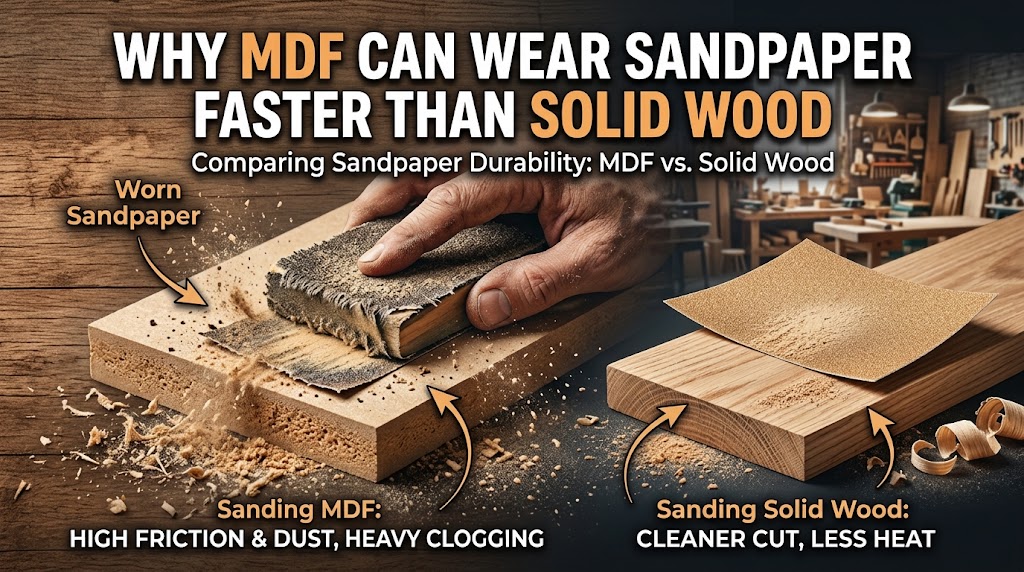
MDF can wear sandpaper faster than solid wood because its dense, resin-bonded structure produces large amounts of fine dust that can quickly fill the spaces between abrasive grains. The problem is not simply that MDF is “harder” than wood. Abrasive loading, resin content, dust generation, sanding pressure, grit selection, and abrasive construction can all affect how quickly sandpaper loses its cutting ability.
Why MDF Can Wear Sandpaper Faster Than Solid Wood
MDF, or medium-density fiberboard, is widely used for cabinets, furniture, shelving, doors, decorative panels, and other woodworking applications. It is smooth, consistent, and easy to machine, which makes it a popular alternative to natural wood.
But anyone who sands MDF regularly may notice something frustrating: sandpaper can seem to wear out much faster on MDF than on solid wood.
The abrasive may still look intact, but it stops cutting effectively. Fine dust builds up on the sanding surface, the abrasive becomes loaded, and operators have to replace discs, sheets, or belts more frequently.
Why does this happen?
The answer has more to do with the structure and composition of MDF than with simple hardness. Understanding how MDF interacts with an abrasive can help users select the right sandpaper and can help abrasive buyers specify products more effectively for woodworking applications.
What Makes MDF Different From Solid Wood?
Solid wood is a natural material made from wood fibers arranged within a cellular structure. Different species have different densities, grain patterns, resin contents, and hardness levels, but the material generally retains the characteristics of natural wood.
MDF is manufactured differently. Wood fibers are broken down into fine particles and combined with resin or adhesive before being compressed into panels under controlled heat and pressure.
The result is a dense and relatively uniform board without the natural grain structure found in solid wood.
That uniformity is one of MDF’s advantages, but it also changes the way the material behaves during sanding.
1. MDF Produces Extremely Fine Sanding Dust
One of the biggest reasons MDF can consume abrasive quickly is the amount and type of dust produced during sanding.
MDF consists of very fine wood fibers and resin. When an abrasive cuts the surface, it can produce a large quantity of fine particles rather than the larger chips or fibers sometimes produced when sanding solid wood.
These fine particles can become trapped between abrasive grains.
This is known as abrasive loading.
Once the spaces around the abrasive grains become filled with dust, the cutting edges are partially covered. The operator may then apply more pressure to compensate, which can increase heat and accelerate abrasive wear.
Key Point
MDF does not necessarily destroy abrasive grains faster simply because it is harder. In many sanding situations, loading is the bigger problem. An abrasive that becomes clogged can stop cutting efficiently even when a significant amount of abrasive grain remains on the backing.
2. Resin and Adhesive Can Contribute to Loading
Unlike solid wood, MDF contains binding materials that hold the wood fibers together.
These resins and adhesives are an important part of the board’s structure, but they can also affect sanding behavior.
During sanding, the combination of fine wood dust and resin-related material can accumulate on the abrasive surface. Depending on the MDF formulation and sanding conditions, this buildup can make the abrasive feel dull even when the abrasive grains have not completely worn away.
This is one reason why a sandpaper specification that works well on ordinary solid wood may not perform equally well on MDF.
For production woodworking, abrasive loading resistance should therefore be considered alongside grit size and abrasive grain type.
3. MDF Has a More Uniform but Dense Surface
Solid wood has natural grain direction, softer areas, harder areas, pores, and other variations. MDF is much more uniform.
This can make sanding predictable, but it also means the abrasive is continuously working against a relatively consistent surface.
When sanding large MDF panels, the abrasive can remain in contact with similar material for long periods. If the abrasive construction is not well suited to the application, loading can develop consistently across the sanding surface.
In high-volume production, this can become noticeable because the same sanding belt or disc may process a large number of panels before replacement.
4. Fine Dust Can Fill the Spaces Between Abrasive Grains
Think of abrasive grains as small cutting tools.
For sandpaper to keep cutting, those cutting points need to remain exposed. The spaces between grains also need to remain sufficiently open to allow removed material to move away from the sanding surface.
MDF dust is particularly fine. Instead of simply falling away from the abrasive, some of it can accumulate around the grain structure.
As loading increases, several things can happen:
- The abrasive removes material less efficiently.
- The sanding surface can feel smoother or less aggressive.
- Operators may increase sanding pressure.
- Heat can increase.
- Surface finish may become inconsistent.
- Abrasive replacement becomes more frequent.
This is why an abrasive’s loading resistance can be just as important as its initial cutting performance when sanding MDF.
5. Grit Selection Also Affects Abrasive Life
Using the wrong grit can make sandpaper appear to wear faster.
A very fine grit may have difficulty removing material efficiently during an early sanding stage. The operator may compensate by applying more pressure, increasing friction and encouraging loading.
On the other hand, using a much coarser grit than necessary can create deeper scratches and require additional sanding steps later.
A controlled grit progression is therefore important.
Instead of asking only, “What grit works on MDF?”, production users should ask:
- What material needs to be removed?
- What surface finish is required?
- How much material should each sanding stage remove?
- How quickly does the abrasive load?
- How long does the abrasive maintain useful cutting performance?
6. Open Coat vs. Closed Coat for MDF
Coat density is another factor worth considering when choosing an abrasive for MDF.
Open coat abrasives have more space between abrasive grains. This creates additional room for dust and sanding debris and can help reduce loading in applications where fine material accumulates quickly.
Closed coat abrasives have a higher concentration of abrasive grains. They can provide a dense cutting surface, but in some MDF sanding applications they may load more quickly if the abrasive construction does not include appropriate loading resistance.
That does not mean open coat is automatically the right choice for every MDF application. Grain type, backing, coating technology, sanding pressure, and the required finish all matter.
The best solution should be determined by testing the complete abrasive construction on the actual MDF material.
7. Sanding Pressure Can Make the Problem Worse
When an abrasive begins to load, operators often respond by pushing harder.
This seems logical, but excessive pressure can make the situation worse.
Higher pressure can increase friction and heat while forcing more dust into the abrasive surface. It can also cause abrasive grains to wear or fracture more quickly.
In many cases, a better approach is to use an abrasive with the appropriate cutting characteristics and allow the abrasive to do the work.
Consistent pressure is especially important in automated and production sanding, where small differences can become significant across hundreds or thousands of panels.
8. Dust Extraction Matters More Than Many Users Expect
Good dust extraction cannot replace the correct abrasive, but it can make a significant difference in sanding performance.
Removing MDF dust from the sanding area helps prevent particles from accumulating around the abrasive and workpiece.
Poor extraction can result in more dust remaining near the sanding interface, increasing the chance of loading and reducing visibility during manual operations.
For production environments, abrasive selection and dust collection should therefore be considered together rather than as separate issues.
How to Make Sandpaper Last Longer When Sanding MDF
If abrasive consumption is high when sanding MDF, several adjustments can help.
- Choose an abrasive designed for the application. Look for suitable loading resistance rather than choosing only by grit.
- Use an appropriate grit progression. Avoid forcing a fine abrasive to perform heavy stock removal.
- Control sanding pressure. Excessive pressure can increase heat, friction, and abrasive wear.
- Maintain effective dust extraction. Removing fine MDF dust can help reduce buildup on the abrasive.
- Check the abrasive construction. Backing, grain type, coating density, and bonding all affect performance.
- Monitor actual abrasive life. Record how many panels, square meters, or parts can be processed before replacement.
How Should Manufacturers and Buyers Compare Abrasives for MDF?
For professional woodworking operations, the lowest purchase price does not necessarily mean the lowest sanding cost.
A more useful comparison is cost per usable sanding area.
For example, an abrasive that costs slightly more per belt or disc may still provide a lower overall cost if it maintains effective cutting performance for longer and requires fewer replacements.
When evaluating abrasive samples for MDF, consider measuring:
- Initial cutting performance
- Material removal rate
- Loading after a defined sanding period
- Usable abrasive life
- Surface finish
- Dust behavior
- Backing durability
- Consistency between abrasive batches
This type of testing gives buyers a much better picture of real production performance than comparing unit prices alone.
MDF vs. Solid Wood: Why Abrasive Selection Matters
| Factor | MDF | Solid Wood |
|---|---|---|
| Material structure | Compressed wood fibers and resin | Natural wood structure |
| Dust | Often very fine | Varies by species and operation |
| Grain direction | No natural grain direction | Natural grain structure |
| Loading concern | Can be significant | Depends on species and sanding conditions |
| Abrasive consideration | Loading resistance and consistent cutting | Grain direction, hardness, cutting and finish |
The Bottom Line
MDF can wear sandpaper faster than solid wood, but the main issue is not simply that MDF is harder. Its fine fiber structure, resin content, dense surface, and high volume of fine sanding dust can create conditions that cause abrasive loading and reduce effective cutting performance.
Once an abrasive becomes loaded, users may apply more pressure, generate more heat, and replace the abrasive more frequently. The result is higher abrasive consumption and potentially higher production costs.
The solution is not necessarily to use a coarser grit or a more expensive abrasive. Instead, look at the complete sanding system: abrasive grain, coat density, backing, loading resistance, grit progression, sanding pressure, machine settings, and dust extraction.
For businesses purchasing abrasives in volume, the most reliable approach is to test different constructions on the actual MDF material and compare cutting performance, loading, surface finish, and usable life.
Looking for the Right Abrasive for MDF Sanding?
Abrasive performance can vary significantly depending on the MDF formulation, sanding equipment, grit, and production conditions. For bulk orders or private-label abrasive products, sample testing is a practical way to identify the right combination of abrasive grain, backing, coating, and grit for your application.
