
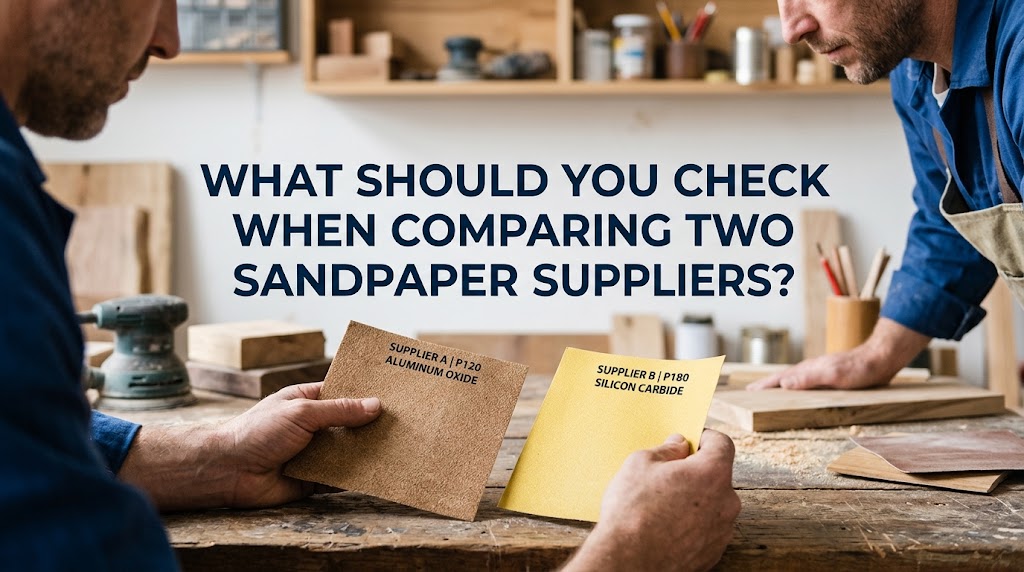
When comparing two sandpaper suppliers, price should not be the only factor. Buyers should also compare abrasive grain, backing material, coating, bonding, product consistency, testing, packaging, production capacity, lead time, customization, and after-sales support. A lower unit price may not result in a lower total cost if the abrasive wears quickly or performs inconsistently.
What Should You Check When Comparing Two Sandpaper Suppliers?
Choosing between two sandpaper suppliers can look simple at first. One supplier offers a lower price, while the other promises better quality. Both may provide similar grit sizes, dimensions, packaging, and product photos.
But coated abrasives are more complicated than they appear. Two products with the same grit number can have very different performance because of differences in abrasive grain, backing, coating structure, bonding, and manufacturing consistency.
This becomes especially important when purchasing abrasives in bulk. A small difference in product performance can become a significant cost when thousands of discs, sheets, rolls, or belts are used.
So how should you compare two sandpaper suppliers before placing an order?
The best approach is to evaluate the complete supply chain and product specification, not just the quotation.
1. Compare the Abrasive Grain
Start with the abrasive grain because it directly affects cutting behavior, durability, surface finish, and application suitability.
Common abrasive grains include aluminum oxide, silicon carbide, zirconia alumina, and ceramic. They do not perform identically, even when they are offered in the same grit range.
When comparing two suppliers, ask:
- What type of abrasive grain is used?
- What is the grain specification?
- Is the grain suitable for the target material?
- How does the abrasive perform during continuous sanding?
- Is the grain consistent between production batches?
For example, ceramic abrasives may be selected for demanding applications requiring aggressive cutting and long working life, while aluminum oxide can provide a versatile and cost-effective solution for many general-purpose applications.
The important point is that “same grit” does not mean “same performance.”
2. Check the Backing Material
The abrasive grain gets most of the attention, but the backing is equally important.
Sandpaper may use paper, cloth, film, or other backing materials depending on the product and application. The backing influences flexibility, tear resistance, dimensional stability, edge performance, and how the abrasive behaves under pressure.
When comparing suppliers, do not simply ask whether they use “high-quality backing.” Ask for the actual backing specification.
Important factors can include:
- Backing type and weight
- Thickness
- Flexibility
- Tensile strength
- Tear resistance
- Water resistance where applicable
- Dimensional stability
A stronger backing may be particularly important for applications involving high sanding pressure, machine sanding, or continuous production.
3. Ask About the Coating Structure
Another important specification is how abrasive grains are distributed across the backing.
Depending on the product, buyers may encounter open coat or closed coat constructions.
Open coat abrasives have more space between grains, which can provide greater room for sanding debris and help reduce loading in suitable applications. Closed coat abrasives have a higher grain density and can provide a dense cutting surface.
Neither construction is universally better. The correct choice depends on the material and sanding process.
When comparing suppliers, ask whether the two products actually have the same coating structure. If one supplier offers a closed coat product and the other offers an open coat product, comparing their prices alone will not tell you which is the better value.
4. Evaluate Bonding and Grain Adhesion
Abrasive grains need to remain securely attached to the backing throughout the sanding process.
The bonding system affects grain retention, durability, and overall abrasive life. If the bond is inconsistent, grains may detach prematurely even when the abrasive itself has not reached the end of its useful life.
For buyers comparing suppliers, this is an area where sample testing is especially useful.
Look for:
- Premature grain shedding
- Uneven grain distribution
- Peeling or delamination
- Weak edges or converting problems
- Changes in performance during extended sanding
A supplier should also have a controlled manufacturing process for adhesive application, grain coating, drying, and curing.
5. Test Cutting Performance Instead of Relying on Samples That “Feel Good”
A sample can look excellent when you first receive it. That does not necessarily mean it will perform well during production.
When comparing two suppliers, use the same sanding machine, material, grit, pressure, and operating conditions for both samples.
Then compare:
- Initial cutting speed
- Material removal rate
- Scratch consistency
- Heat generation
- Loading
- Useful abrasive life
- Final surface finish
If possible, test the abrasive over a defined sanding area rather than for only a few seconds. A product that cuts aggressively at the beginning but loses performance quickly may not be the best choice for production use.
A Better Comparison
Instead of asking only, “Which supplier has the cheaper sandpaper?”, ask, “How much usable sanding performance do I get from each product?”
6. Check Abrasive Life and Loading Resistance
Abrasive life is particularly important for customers purchasing large quantities.
If one disc lasts twice as long as another, the higher-priced disc may actually have a lower cost per completed job.
Loading should also be measured. Materials such as MDF, softwood, paint, primer, aluminum, and some composites can create significant loading problems.
Ask suppliers about the abrasive’s loading resistance and whether the product uses technologies such as anti-loading treatments or stearate coatings where appropriate.
However, avoid accepting vague claims such as “long-lasting” without testing. The best evidence is performance under your actual sanding conditions.
7. Look at Quality Control and Batch Consistency
A good first sample is useful, but consistent production is even more important.
This is one of the biggest differences between evaluating a product and evaluating a supplier.
A supplier should have processes for controlling raw materials, abrasive coating, adhesive application, curing, converting, packaging, and final inspection.
Ask:
- How are incoming raw materials inspected?
- What performance characteristics are tested?
- How are production batches identified?
- How are nonconforming products handled?
- Can the supplier provide inspection or test information?
Consistency matters because distributors and brands need the product they receive six months from now to perform similarly to the product they approved today.
8. Compare Manufacturing Capacity
A supplier may provide an attractive quotation for a small order but struggle to maintain the same quality and delivery schedule when order volume increases.
If you are sourcing abrasives for distribution or private-label sales, check the supplier’s actual manufacturing capacity.
Consider:
- Production lines
- Monthly capacity
- Converting capability
- Raw material availability
- Production scheduling
- Ability to handle repeat orders
Capacity does not automatically equal quality, but reliable production capacity can reduce supply interruptions and make long-term planning easier.
9. Check MOQ and Production Flexibility
Minimum order quantity can have a major effect on sourcing decisions, especially when launching a new product or testing a new market.
Compare not only the supplier’s standard MOQ but also their flexibility for:
- Different grits
- Different sizes
- Custom packaging
- Private-label products
- New product development
- Trial orders
A slightly higher unit price from a flexible supplier may be more practical than a lower quotation that requires a large inventory commitment.
10. Compare OEM and Private-Label Capabilities
If you are developing your own abrasive brand, supplier capability goes beyond manufacturing standard products.
Check whether the supplier can support:
- Custom product specifications
- Private-label packaging
- Custom labels and product identification
- Different grit ranges
- Product development
- Packaging artwork requirements
- Barcode and carton labeling
It is also worth asking who controls the product specification. A manufacturer with technical expertise should be able to discuss why a particular backing, grain, coating, or bonding system is suitable rather than simply offering the lowest-cost version.
11. Review Packaging and Product Protection
Sandpaper can be damaged by moisture, pressure, bending, contamination, or poor handling during storage and transportation.
Packaging should therefore be considered part of the product specification.
Check:
- Individual product packaging
- Grit identification
- Quantity per package
- Inner and outer cartons
- Moisture protection where required
- Label accuracy
- Carton strength
For private-label customers, packaging consistency is particularly important because it directly affects how the product is presented to the end market.
12. Compare Lead Times and Communication
Product quality is only one part of supplier performance.
A supplier who cannot communicate clearly about production schedules, specifications, changes, or problems can create additional costs even when the product itself is acceptable.
Before placing a large order, evaluate how quickly and accurately the supplier answers technical questions.
A reliable supplier should be able to clearly communicate:
- Sample lead time
- Production lead time
- Shipping arrangements
- Specification changes
- Quality issues
- Repeat-order requirements
13. Compare the Total Cost, Not Just the Unit Price
Price is important, but it should be evaluated in context.
Consider this simple example:
| Cost Factor | Supplier A | Supplier B |
|---|---|---|
| Unit price | Lower | Higher |
| Abrasive life | Shorter | Longer |
| Loading resistance | Lower | Higher |
| Replacement frequency | Higher | Lower |
In this situation, Supplier B could have the higher purchase price but the lower cost per completed sanding job.
For production users, this is often a more meaningful measurement than unit price alone.
A Practical Supplier Comparison Checklist
Before selecting a sandpaper supplier, you can use the following checklist:
- ☐ Abrasive grain type and quality
- ☐ Grit consistency
- ☐ Backing specification
